
PMO - Project Management
Differences Between PMO and VMO
Differences between PMO and VMO: two structures are essential to drive organizational efficiency and competitiveness.
It is important to understand the differences between PMO and VMO. As organizations seek to improve their efficiency, effectiveness, and competitiveness, they turn to specific structures and practices to manage projects and maximize the value added to their businesses. In this context, two key approaches emerge: the Project Management Office (PMO) and the Value Management Office (VMO). Although both play crucial roles in business management, their functions, objectives, and methods can vary significantly. This article explores the fundamental differences between PMO and VMO, highlighting their distinct characteristics and how each contributes to organizational success.
First, what is a PMO?
Portfolio, Program, and Project Management Offices (PMOs) take different forms, offering functions and services according to the organization's unique business needs. Effective management of portfolios of programs, projects, products, and/or services usually does not occur in isolation, without the participation of a Portfolio, Program, and/or Project Management Office. In other words, it provides a decision-support function that assists in decision-making activities that require judgment and a sequence of actions to optimize return on investment. Naturally, there is no PMO model that applies to every organizational scenario.
What is a VMO?
In 2015, Robert Kaplan discussed the concept of the Value Management Office (VMO), noting that organizations today seek to deliver benefits at a lower cost and, as such, are reaping the rewards of achieving both. Simply put, a VMO is about putting knowledge into practice while measuring the expected tangible benefits, which should be the justification and driver for that investment.
A Portfolio, Program, and/or Project Management Office (PMO) can offer this service, but the change in title signals to everyone in the organization that benefits realization, not initiative delivery, is what really matters.
As Thorp, J. (2003) says, it "acts as an advocate for changing the organizational mindset in the way people think about both benefits and value". It makes much more economic and operational sense to create and leverage a centralized group of benefits management professionals than to ask each business or functional unit individually to acquire such expertise, especially to optimize return on investment.
The primary objective of the VMO, as the name suggests, is to deliver value. The central purpose of the VMO is to ensure strategic alignment through metrics that monitor projects across all their stages: from conception to scaling. Functioning as governance, the VMO supports project teams by solving any obstacles or pending issues that may arise during the project.
Companies of any size or segment may have several projects underway at any time, whether formally recognized or not. Larger organizations span marketing, business development, product and service development, technology, capital, business improvement, finance, human resources, and the list goes on. So what are the differences between PMO and VMO?
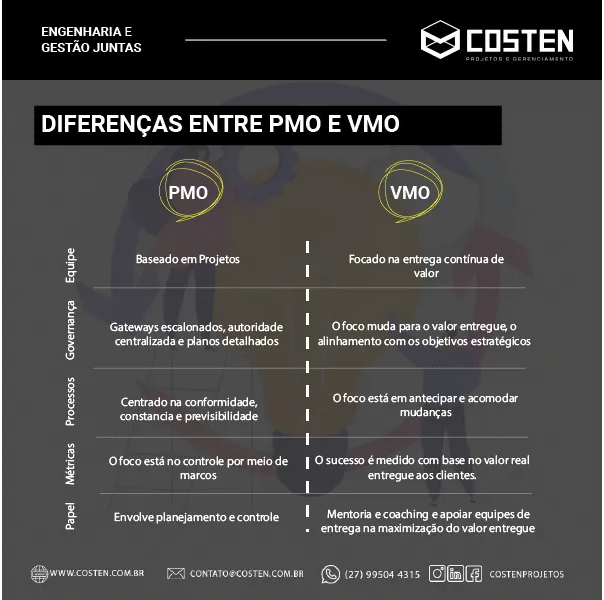
- PMO (Project Management Office):
- The PMO is an organizational structure or department within a company responsible for standardizing and improving project management practices.
- The main objective of the PMO is to provide support, guidance, and oversight for projects throughout the organization, ensuring they are delivered within the defined schedule, budget, and requirements.
- The PMO can offer a variety of services, including development of project management methodologies, provision of tools and resources for project managers, project reviews and audits, and facilitation of communication among different stakeholders.
- VMO (Value Management Office):
- The VMO is an organizational structure focused on maximizing value for shareholders or stakeholders.
- The main objective of the VMO is to ensure that investments in projects and initiatives are aligned with the company's strategic objectives and provide the maximum return on investment.
- The VMO is generally involved in the selection, prioritization, and monitoring of projects and initiatives, ensuring they contribute to value creation and achievement of the organization's strategic objectives.
- The VMO can use techniques such as cost-benefit analysis, return on investment (ROI) analysis, and value analysis to identify and prioritize the projects that offer the greatest value to the organization.
How to transition from a PMO to a VMO?
In summary, the PMO-to-VMO transition process involves the following steps:
- Focus on outcomes, ensuring a sustainable flow in value delivery.
- Transform the mindset from Project to Product.
- Start the transition with a product from an area that already has budget, projects, and teams integrated with the traditional PMO.
- Communicate the new VMO approach to those involved.
- Share planning and results broadly, involving the entire team.
- Map the value chain (Value Stream).
- Adopt a more horizontal view, ranging from strategic definitions to continuous product evolution, considering customer demands.
- Integrate people, systems, processes, assets, and policies synergistically.
- Change the financial mindset, shifting the focus from project to the value chain that generates the product.
- Adopt the perspective of multifunctional teams.
- Use lightweight visual resources, keeping them continuously visible to key stakeholders.
- Facilitate quick decision-making.
- Preserve the simplicity of the information provided.
- Incorporate quality into results and actions.
In short, while the PMO focuses on the effective management of projects within the organization, the VMO is more concerned with maximizing the value of investments in projects and initiatives to meet the company's strategic objectives. Although they may have different objectives, both play important roles in the success and effectiveness of an organization's operations.
Source: https://ensembletechnology.com/the-value-management-office/