
PMO - Project Management
Agile PMO and the BAM Framework
Agile PMO and BAM Framework - agile methods are here to stay and expand into several areas, reaching the project office PMO.
Agile, Scrum, Kanban, XP, incremental, adaptive, iterative... we are surrounded by agile terms and methods. They are here to stay and expand across many areas, no longer limited only to IT projects, reaching the Agile PMO project office and making use of several frameworks, including BAM, Business Agility Management.
The Agile PMO (Agile Project Management Office) is an approach that combines agile principles and practices with the traditional role of the Project Management Office (PMO). While the traditional PMO focuses on process standardization, project performance monitoring, and ensuring compliance with standards, the Agile PMO adapts to the dynamics and flexibility required by agile methods.
By adopting an agile approach, the Agile PMO aligns with the fundamental values of the Agile Manifesto, such as collaboration, adaptation to change, continuous delivery, and customer focus. This means the Agile PMO not only supports the implementation of agile practices, but also promotes an organizational culture that values agility, enabling a fast and effective response to market changes and customer needs.
Business Agility Management (BAM) is a framework that aims to guide organizations on the journey to becoming agile in every aspect of the business. It covers not only software development, but also areas such as strategy, governance, organizational culture, operations, and marketing. BAM provides a set of practices and principles to help organizations adapt and thrive in an increasingly complex and volatile business environment.
When combined with the Agile PMO, the BAM framework can provide valuable guidelines for organizational transformation.
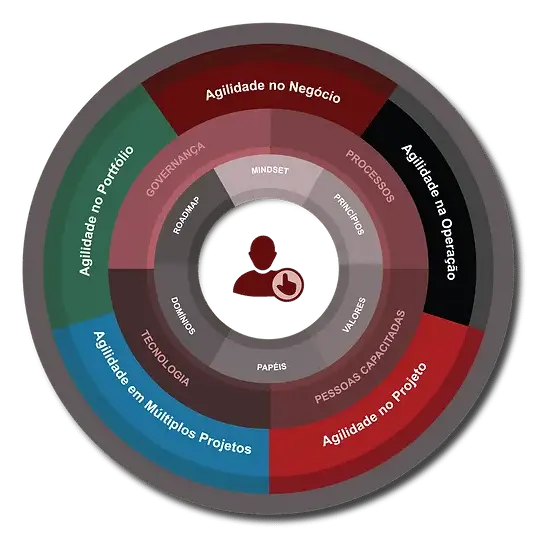
In the inner layer, we have the basic elements:
- Mindset: means mental model, worldview, and thinking patterns that influence our ability to make good or bad choices and decisions. Creating a culture of agility and lean thinking is the "cornerstone" of the framework.
- Principles: These are foundations, points considered initial, or the primary essence for implementing the framework.
The 10 principles are:
- Focus on people;
- Transparency at all levels;
- Adaptation to change as soon as possible;
- Anticipation of return on investment (ROI);
- Value generation in an iterative and incremental way;
- Customer focus;
- Creation of value flow;
- Continuous delivery flow;
- Pull production;
- Perfection (continuous improvement).
- Values: These are the beliefs and attitudes that give personality to the framework and should serve as guides and parameters for everyone involved in its implementation.
The 5 values are:
- Adaptability;
- Learning;
- Collaboration;
- Courage;
- Focus and pragmatism.
Roles: These are the functions and responsibilities that must be performed by people, individually or in groups, in the effort to "descend" or "scale" customer-centered agility.
Domains: A domain is a part of the whole organization that needs to integrate with the others to implement business agility. They are "logical layers" of the organization, which may or may not correspond to "boxes in the org chart", and which need to be guided and integrated by agility.
Roadmap: It is a route to be followed to implement something, in a visual and descriptive way, as if it were a map of the road to be followed. It defines the steps to implement the framework.
In the intermediate layer, we have the pillars of professional management of the project, program, and portfolio portfolio, which need to be used within each domain for us to achieve success:
- Governance: Defines the rules, guidelines, and responsibilities of those involved in project, program, and portfolio management.
Processes: It is the sequence of steps that must be followed, the set of inputs, techniques/tools, and outputs to be used for managing projects, programs, and portfolio. They may compose frameworks or methodologies.
Trained people: All work will be done by people for people, who need to have a set of technical and behavioral capabilities to achieve success.
Technology: Corresponds to the automated set of processes and tools to collect, process, analyze, distribute, and store all information related to the framework. Management without technology is bureaucracy without agility.
In the outer layer we have the frameworks related to the 5 domains:
- Business agility: Its objective is to implement business agility, which means an organization's ability to quickly adapt to changes in the external and internal environment.
Portfolio agility: seeks to optimize the organization's investments, aiming to achieve the maximum strategic value, using organizational resources in the best possible way, within existing limitations, whether financial, people, equipment, infrastructure, or any other.
Agility in multiple projects: seeks to scale agility in managing multiple projects. The structural flexibility of the framework allows adaptations to approaches that may already have been adopted by the organization, such as program management and PMOs (Project Management Office) or VMOs (Value Management Office).
Project agility: Its objective is to implement agility in projects and scale agility to several development teams working in an integrated way on the implementation of a single product.
Operational agility: Aims to create agility in the continuous and repetitive operations that must be executed to maintain the organization's business. The framework provides, through agile practices and metrics adherent to the context, support for identifying the organization's value chain and, within it, the value stream (VSM - Value Stream Mapping).
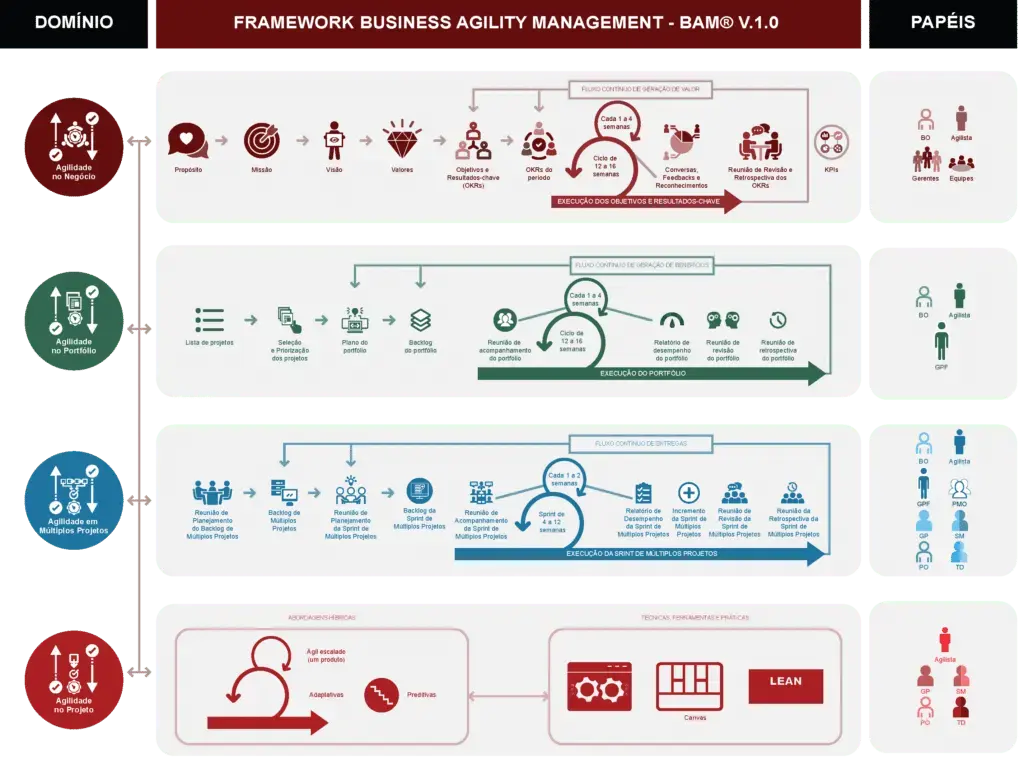
In summary, the Agile PMO, when combined with the BAM framework, can play a fundamental role in promoting business agility, allowing organizations to adapt and thrive in an increasingly dynamic and competitive business environment.
Source: https://www.bamagility.com.br/framework
See more at: /blog/