
Occupational Safety
Occupational Safety Culture
Occupational Safety Culture is stronger than any direct order or strategy. See the importance of practicing this culture.
Occupational Safety Culture: why is it so expensive not to have it?
Before continuing to read, answer the following question:
HOW MANY OCCUPATIONAL SAFETY PROFESSIONALS ARE THERE IN YOUR COMPANY?
NR 4 establishes the framework for sizing occupational safety professionals who are required to work daily as part of the company's effective staff.
This means that it sizes only according to what the law requires, having these professionals merely to comply with legislation, which weakens the work of this type of professional and often delegates to them activities that compromise the dedicated work of an Occupational Safety Culture.
And when the company is not legally required to have these professionals, the occupational safety culture disappears.
But what if it were possible to practice the occupational safety culture simultaneously, with your processes running smoothly, even when there are no full-time professionals?
What is Occupational Safety Culture?
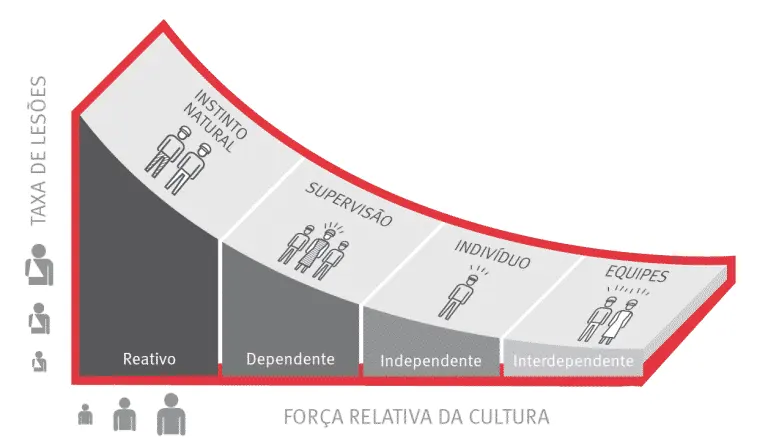
Bradley Curve
Since 1995, it has been the philosophy that safety culture is based on 4 stages:
1st reactive stage - No one cares as long as nothing happens. Employees do not take responsibility; they believe accidents happen because of bad luck, and when they do not happen, it is luck.
Management is indifferent, and the injury rate is usually high.
2nd dependent stage - It requires a great deal of effort from supervision, because employees tend to follow the rules only when they are told and charged to do so. Safety is important, but we only actually act when an accident happens.
The injury rate decreases and the team believes that accidents can be controlled.
3rd independent stage - Employees have self-responsibility regarding safety and believe they have the potential to make a difference through their actions. Safety is internalized in leadership and the company recognizes safety as a value that guides its actions toward continuous improvement.
The injury rate decreases significantly.
4th interdependent stage - This is the peak of the maturity of the safety culture, because employees truly internalize their responsibility not only for their own protection, but also for the safety of their colleagues. Failures serve as a stimulus for increasingly robust solutions, and the vision is focused on solutions rather than blame.
This is indeed a robust, self-sustaining safety culture, with rates tending toward zero.
Why invest in Occupational Safety Culture?
Everyone could have answered the initial question as follows:
"EVERYONE is at least involved in occupational safety."
Therefore, we need to integrate multidisciplinary professionals, identifying common points among these professionals and maximizing the performance of the results of this connection. For good communication, it is necessary to listen beyond what is being said.
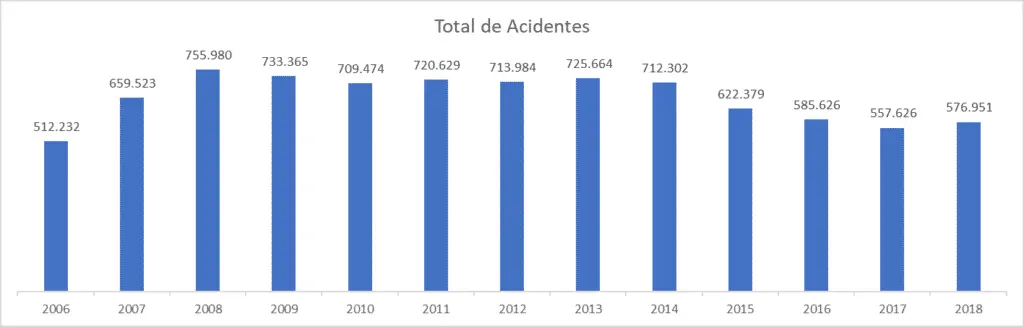
Unfortunately, in Brazil the number of workplace accidents is extremely high compared to other countries, not to mention the precarious intervention and coverage that companies and injured workers will hardly have after an accident.
We see that the number of workplace accidents was constantly growing until 2014, and after that there was a slight decline. Of course, conditions in some work sectors improved, which caused this number to fall, but make no mistake: after 2014 there was also a serious economic crisis, unemployment, and process automation through machines.
The costs of a workplace accident only become visible when the accident actually occurs, bringing emotional and financial losses, with the employee's leave, employee replacement, new training, machinery repair, production and process shutdowns, and in some cases even company shutdown, in addition to punishment and judicial compensation.
Therefore, the safety culture is qualitative and human in company management, carried out by employees and contributors. So do not hire and simply place these people on the factory floor or in the office; train/model/shape these people.
COSTEN - Projects and Management specializes in Occupational Safety Engineering. We provide this holistic view of the entire company, integrating employees, managers, and strategy teams.