
PMO - Project Management
Eisenhower Matrix (Importance vs. Urgency)
Eisenhower Matrix (Importance vs. Urgency), a simple and extremely effective framework for managing time-related tasks.
The Eisenhower Matrix, also known as the importance vs. urgency matrix, is one of the tools used to better prioritize your daily tasks.
Being unproductive is rarely anyone's intention, much less at work. But as the day goes by and you begin to respond to urgent requests while your task list keeps growing, it becomes increasingly difficult to maintain that commitment to productivity.
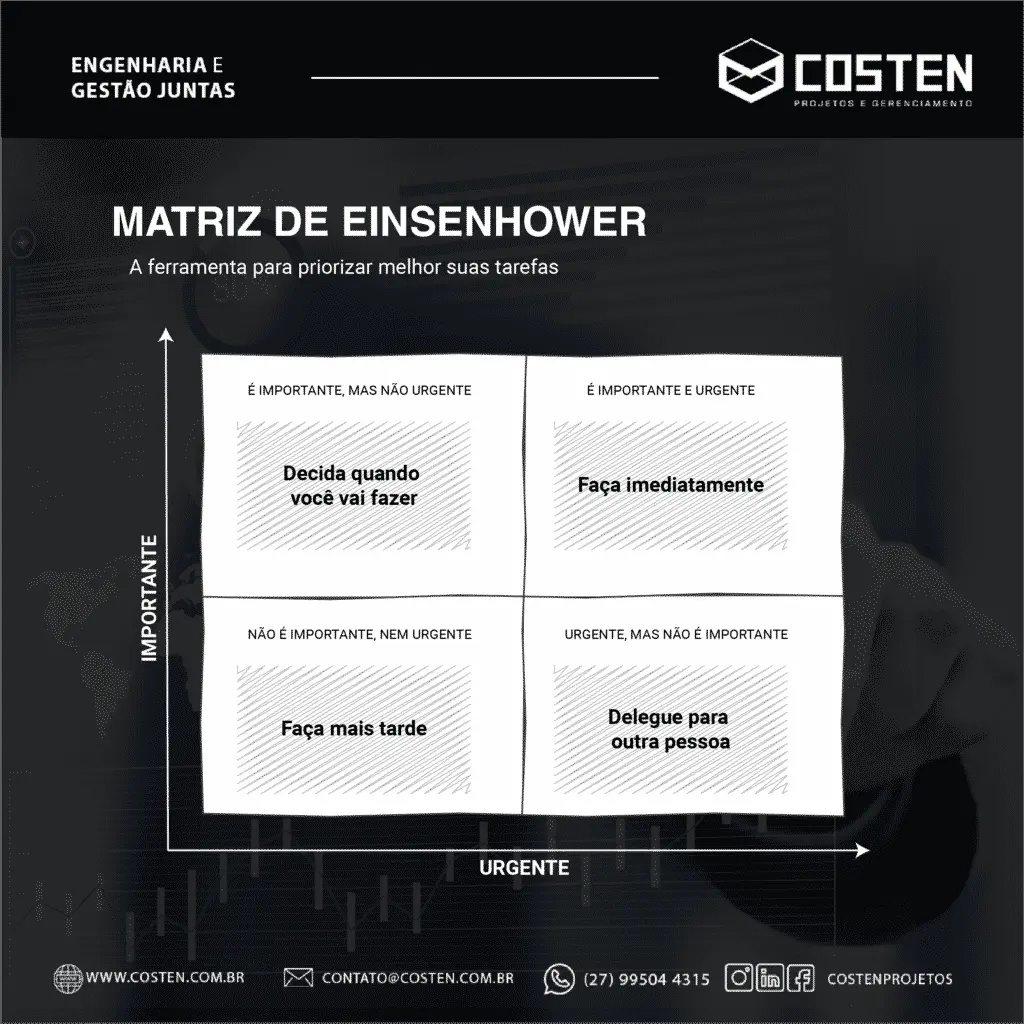
It is a simple framework for prioritizing tasks and managing workload. Its name is a tribute to Dwight D. Eisenhower, a five-star general and the 34th president of the United States.
Main benefits of the Eisenhower Matrix (Importance vs. Urgency)
- Prioritization of the most urgent and important tasks for the company;
- Improvement in productivity levels;
- Greater organization and clarity of activities;
- Resolution of possible problems;
- Greater agility in task execution;
- Favoring reason over emotion;
- More assertive decision-making.
How do you distinguish between urgency and importance?
In short, urgent tasks are unavoidable and require immediate attention, while important tasks require more planning and contribute to long-term goals. For example, answering phone calls from an important client is urgent, while keeping up with the latest research in your field is important.
How does the Eisenhower Matrix (Importance vs. Urgency) work?
Companies and individuals can use the Eisenhower Matrix (Importance vs. Urgency) to plan, delegate, prioritize, and schedule daily or weekly tasks. By assigning tasks to one of the four quadrants below, you can determine their urgency and discover how to handle them appropriately:
- First quadrant: urgent and important (tasks to be completed immediately). These are "do first" tasks that are vital and must be resolved as quickly as possible. They are usually last-minute requests that arise due to unforeseen circumstances. In general, tasks like this must be completed immediately or on the same day. Examples include covering a project for a sick colleague or dealing with an unexpected emergency, such as a supply chain disruption.
- Second quadrant: important, but not urgent (tasks to schedule for later). These are long-term goals/tasks that are important, but do not have a particularly strict deadline, so you can schedule them for later completion. Examples include obtaining a professional qualification or planning for a long-term business goal, such as budget reduction.
- Third quadrant: urgent, but not important (tasks to delegate to someone else). These tasks need to be completed immediately, but may not be important enough to require your attention, which means they can be delegated to other members of your team. Examples include routine work or long meetings/phone calls without a clear purpose.
- Fourth quadrant: neither urgent nor important (tasks to be eliminated). These tasks are a distraction and should be avoided, if possible. In many cases, you can simply ignore or cancel these types of tasks. Examples include social activities or unnecessarily long tea/coffee breaks.
Conclusion
The Eisenhower Matrix (Importance vs. Urgency) can be an extremely effective tool for task and time management. By learning to prioritize tasks effectively, you can improve workplace efficiency, eliminate time-wasting activities, and develop your long-term business goals.